
Step-by-Step Revival Schedule
Wake up your dehydrated starter in four simple stages, then keep it happy with a few quick tips.
Step-by-Step Revival Schedule

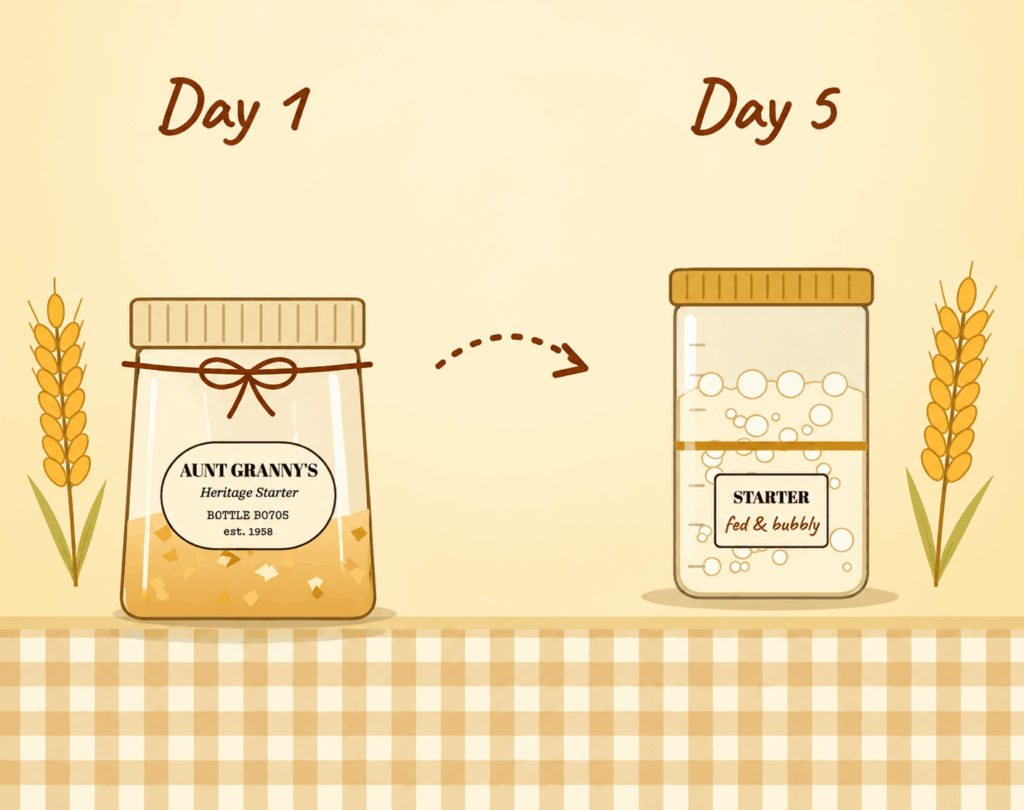
Combine 1 tablespoon (15g) of dehydrated starter with 2 to 3 tablespoons (30g) of warm water in your jar. Let it sit for 30 minutes to 2 hours until the flakes soften and dissolve. Stir in 2 tablespoons (15g to 20g) of unbleached flour until no dry streaks remain. Cover loosely and let it rest in a warm spot (70°F–80°F) for 24 hours.

You may see a few tiny bubbles or a slightly tangy smell, though it might still look quiet. Do not discard anything yet. Add 2 tablespoons (30g) of flour and 2 tablespoons (30g) of lukewarm water directly into the jar. Mix into a thick paste, cover loosely, and rest for 12 to 24 hours.

Once you see active bubbling, discard about half of the starter (or transfer 2 tablespoons to a clean jar). Feed the remaining starter with 1/4 cup (30g) of flour and 2 tablespoons (30g) of warm water. Place a rubber band around the jar at the top line of the mixture to track its rise.

Continue discarding half and feeding daily at a 1:1:1 ratio by weight (equal parts starter, water, and flour). Once the starter doubles or triples in size within 4 to 8 hours of a feeding and looks foamy and domed on top, it is ready to bake.
Keep it happy
Always feed your starter with filtered, spring, or dechlorinated water. Do not use unfiltered tap water, as it often contains chlorine or chloramines designed to kill bacteria, which will also kill or stunt the beneficial wild yeast and bacteria in your culture.
Keep the starter in an ideal ambient temperature of 75°F to 80°F (24°C to 27°C). Cold kitchens below 70°F make dormant cultures sluggish, so try placing the jar on top of the refrigerator or inside an off oven with just the light turned on.
After stirring in fresh flour and water, the mixture should resemble thick pancake batter or smooth paste rather than runny liquid.
Drop a half-teaspoon of bubbly starter into a glass of room-temperature water. If it floats to the top, it is full of gas and ready for bread dough.
Benefits
Traditional sourdough relies on a live culture of wild yeast and lactic acid bacteria rather than commercial yeast, giving it a distinct nutritional and structural edge over standard loaves. Because the fermentation takes time, the microbes pre-digest complex starches and reduce compounds like phytic acid, which makes minerals such as iron, zinc, and magnesium much easier for your body to absorb.
This extended natural rise also yields a lower glycemic index, which helps smooth out energy levels instead of causing sharp blood sugar spikes. In short, it is a clean, additive-free staple crafted from just flour, water, salt, and time.
Wild yeast and lactic acid bacteria pre-digest starches and break down FODMAP carbohydrates and gluten proteins during fermentation. This reduces bloating and makes sourdough gentler on sensitive stomachs, including some individuals with irritable bowel syndrome (IBS).
Fermentation alters the carbohydrate structure and creates resistant starch, giving sourdough a lower glycemic index than standard white bread. Sugars enter the bloodstream more slowly, helping prevent rapid blood glucose spikes and supporting sustained energy.
Grains naturally contain phytic acid, a compound that blocks your body from absorbing minerals. According to University Hospitals, sourdough fermentation breaks down phytic acid, freeing up iron, zinc, and magnesium so your body can absorb them easily.
Sourdough acts as a source of prebiotics and resistant starch, which feed beneficial bacteria in your digestive tract. Choosing whole-grain sourdough boosts fiber content even further for digestive and cardiovascular health.
As outlined by Colorado State University Extension, authentic sourdough relies solely on flour, water, salt, and starter. The lactic and acetic acids produced during fermentation naturally prevent mold growth without artificial additives or chemical preservatives.
Pick a starter kit, add water and flour, and follow the schedule above.